
May 14, 2026
"Take only what you need from it"

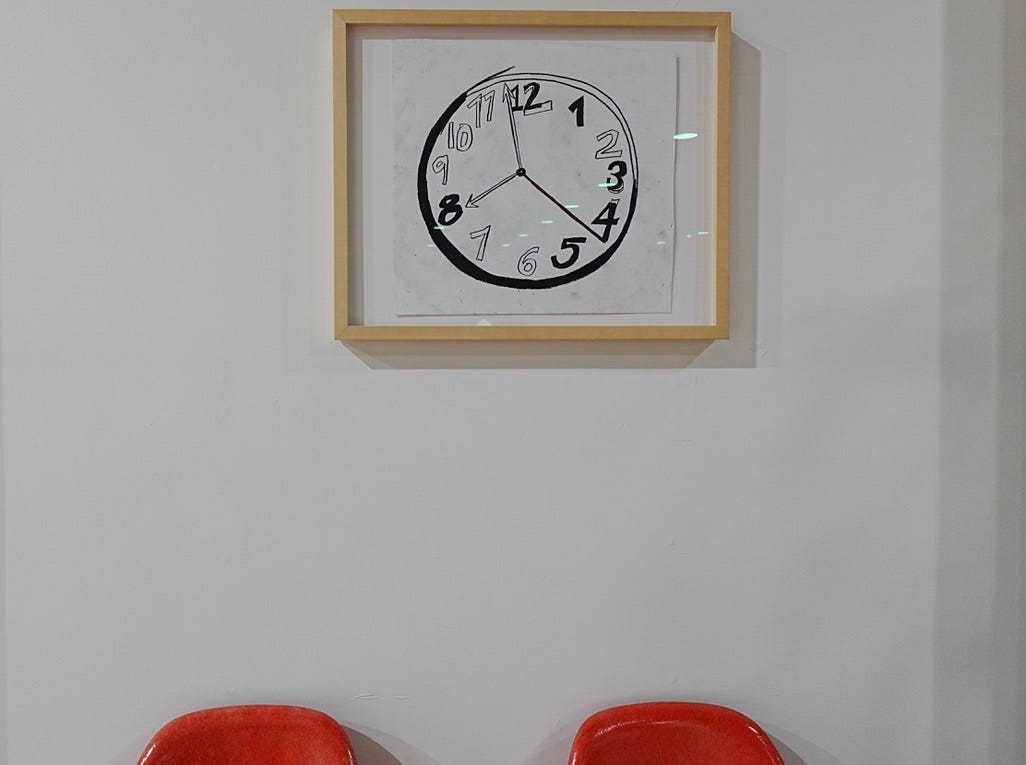
Hello.
What do you need?
What if we said this routinely instead of, Hi. How are you? What if it was our customary greeting?
- Hi. What do you need?
- I need a ride to the airport on Saturday. What do you need?
- I need to stop holding my breath.
The unspoken rule would be we don’t comment or offer problem-solving, but the conversation would move on from there. It could be beautifully awkward.
*
I’m not an expert, I’ve only been to two Al-Anon meetings, but after people share their experiences, everyone says, “Thank you for sharing,” then someone else volunteers to speak. When I witnessed this, it was kind of jarring. Many of these “shares” expose an acute need, and my freshman mind instantly began downloading possible solutions (rendering me a less effective listener). The no-comment structure—listening without judgement or intervention—made an impression on me. I have activated that model from time to time looking at art and it’s a wild shift.
*
If I’m lost in a painting I’m working on, I sit across from it in the studio and ask what it needs. I know that sounds fruitcakey, but It’s a kind of listening. It’s the kind of thing that was rare if not unheard of in yappy graduate school. I used to think my way through my paintings—and probably other people’s paintings. Then, about fifteen years ago, I began to listen but with my eyes. I stopped trying to aggressively save my paintings from discomfort and instead, through sustained looking, let the next move reveal itself. It’s like they say about raising children: don’t turn on the light for them, sit with them in the darkness.
Other people’s art is not mine to solve or keep company in darkness. though I like to listen for what it needs.
*
After thinking about all of this, about the notion of needs, listening without judgement, and listening with eyes, I looked up Maslow’s “Hierarchy of needs.” He’s not the one who illustrated this conceptualization with a pyramid, though he did set it up in a hierarchy.
I don’t like triangles and I don’t trust pyramid diagrams in general. Anyway, putting needs in a pyramid or hierarchy suggests you’ve never needed belonging or self-esteem more than a sandwich. I think all the needs Maslow identified should be illustrated by fireflies or the Marfa Lights, moving and blinking, surrounded by dark mysterious space. When you try to focus on one need, it blinks out and another one over there starts popping off.
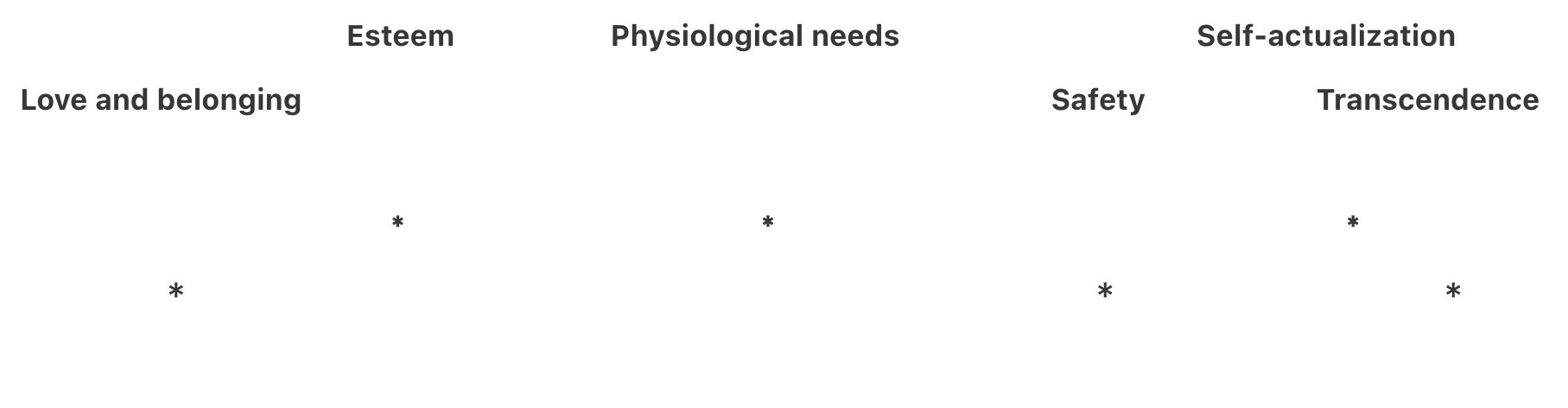
Usually, looking at art, I focus on the art itself, on my encounter with it. But thinking about needs, I’m thinking about the makers. An artwork is an expression of the artist’s voice. Some artworks are more cagy or filtered than others.
(Yet another reason I dislike artist statements: they are decoys, obscuring the artists’s more complex and revealing needs and offering yapping instead.)
I’m looking at these artworks asking What does this artist need? It shifts my perception like putting on 3-D glasses. What I guess they need—and it’s fun to articulate a guess—triggers a feeling of tenderness that bypasses critical response for better or worse.
What we need from art may be what we need in general.
Anyway, below are some things I have seen.
xx,
