
May 7, 2026
Looks like the real thing


Hello.
I am of two minds. I like this expression and often experience some compounded version of it when I am looking at art or thinking about art. In Charles Dickens’ David Copperfield, the protagonist says, “I was in twenty minds at once." After seeing Marcia Mahoney’s solo show Re|structure at Parlour Gallery, I was in twenty minds. As usual. Here are some of my thoughts, some of the thought-paths I could have followed and written about:
Interactive art (some of the works in the show invited audience intervention)
Surface (in general and how surface is affected by audience intervention)
Concept (including and beyond audience)
The “aboutness” (and how it’s in the hands (metaphorically) of the audience)
Scale and the goldfish effect
How to show everything without overcrowding an exhibition
…
And Clement Greenberg. Yes, one of my ten minds has been thinking about the art critic (and bossy unc) Clement Greenberg. Because this is the second show that has activated that ghost, I decided to reread his 1939 essay “Avant Garde and Kitsch.” Reading it is a little like chewing on paper, but it’s been interesting for me to consider these ideas years after I first read (or skimmed) the essay in graduate school.
Greenberg argued that artists must break free from representation and reference. He complained that art, once an elevated cultural activity and product, had fallen to kitsch, which he identified with “vicarious experience and faked sensations.” He argued that the avant-garde would torch-hold the way out of the base and populist slop of mass-produced kitsch:
The avant-garde poet or artist tries in effect to imitate God by creating something valid solely on its own terms, in the way nature itself is valid, in the way a landscape-not its picture -is aesthetically valid; something given, increate, independent of meanings, similars or originals.
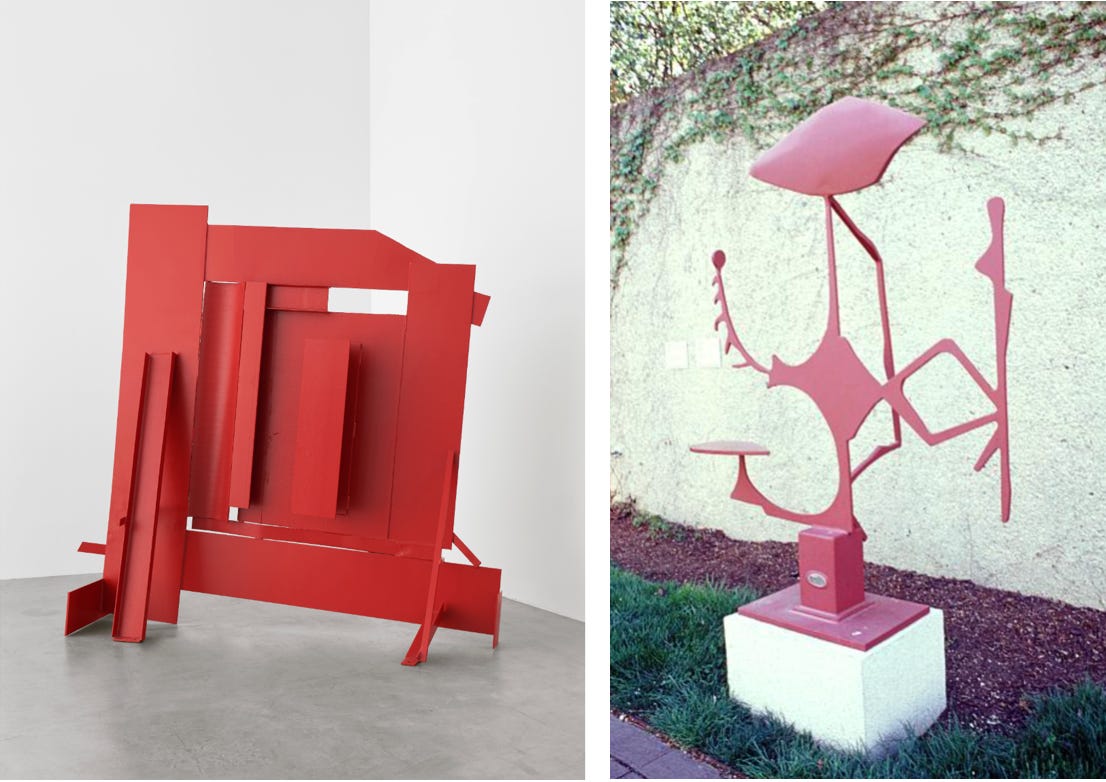
(Clement Greenberg was bananas about artists Anthony Caro and David Smith.)
Its funny. All these years I have rolled my eyes when I think of Clement Greenberg (and certain professors who assigned his essays). Now, I better understand his frustration and craving for something real, the feeling of being surrounded by fake plastic trees. Still—
Not only did Greenberg come off as the Gordon Lish of his moment and art form, not only is his then-you-must-do-this position irritating to read, but there is a significant crack in his 1939 assertion. It seems he failed to recognize—at least at first—that Abstraction, “art for art’s sake” once avant-garde, would suffer the same fate that previous high art had suffered. Abstraction would be created, imitated, and regurgitated like other isms that had become kitsch in the hands of the academics and the bourgeois. Inevitably, artists as well as consumer culture—Pottery Barn, Urban Outfitters, Walmart—would reference, imitate, and mass produce “pure” Abstraction. In a 1945 review, Greenberg wrote, “What may have been the high style of one period becomes the kitsch of another.” Facts.
